
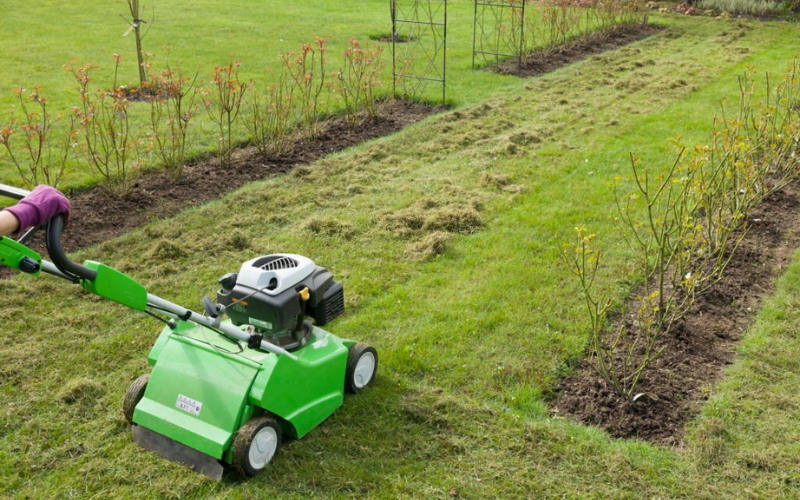
A lawn thatch is a dense mat of dead grass, clippings, and dead insect matter accumulating on the lawn over time. Scarifying removes the thatch on lawn surfaces and ensures water, vital nutrients, and oxygen flow. It also encourages the growth of a healthier and thicker turf.
For this task, you need a scarifier, so we evaluated the best options in Australia and compiled our top picks to help you find one for your lawn and garden needs. They include mechanical, gas-powered, battery-powered, and corded-electric scarifiers, many of which double as lawn aerators and dethatchers.
Our Top Picks
Here is a quick roundup of our top three lawn scarifiers on the Australian market:

Makita UV001GZ Scarifier
Best value cordless lawn scarifier with a 38 cm cutting width, adjustable depth from +5mm to -12mm in 1mm steps, and a 50-litre collection bag.

Greenworks 40V Scarifier
Best battery-powered lawn scarifier with a cutting width of 36 cm, five cutting height steps, and a 45-litre collection bag.
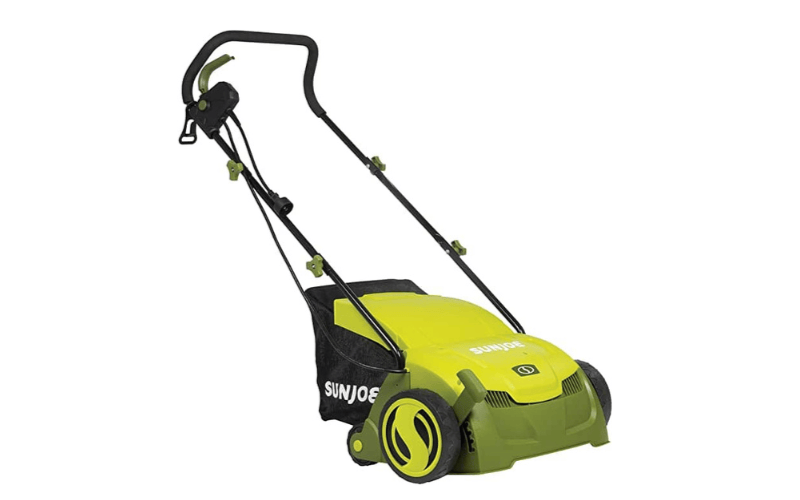
Sun Joe AJ801E Scarifier
Best corded electric lawn scarifier for small to mid-sized lawns, with a 32 cm cutting width, 5-position depth adjustment, and a 30 L collection bag.
Top 6 Lawn Scarifiers for Australians
Our analysis of the lawn scarifiers below considers each scarifier's use cases, product features, user experience, and feedback. The following is a complete assessment of our top picks.
1. Makita UV001GZ Scarifier
Best Value Lawn Scarifier

Cutting width: 38 cm
Cutting height: 18 steps
Collection bag: 50 litres
The Makita UV001GZ is a high-performance cordless scarifier ideal for Australian lawns. It features a 1.7kW brushless motor delivering up to 3,200rpm, making it perfect for dethatching and vertical cutting. The 38cm cutting width and adjustable working depth from +5mm to -12mm (with 1mm increments) ensure precise and efficient lawn care.
This scarifier has a 50-litre collection container for hassle-free operation. Its robust design includes large 180mm front and rear tyres, rear discharge, and a foldable, height-adjustable handle for easy storage. You also get advanced features like automatic battery switching (for two batteries, not included), a lock-off function, and an electric brake for safety.
The scarifier's battery is part of Makita’s 40V XGT system, ensuring powerful performance and fast charging. Combined with its durable, water-resistant cutting deck, constant speed control, and 1-year warranty, the UV001GZ is built for tough grass and easy moss removal.
Pros
- Precise depth adjustment
- Robust motor with speed control
- Large wheels for stability
- Easy to operate
Cons
- Noisy during operation
- Slight vibrating in operation
- Skin only
2. Greenworks 40V Dethatcher & Scarifier
Best Battery-Powered Lawn Scarifier
Cutting width: 36 cm
Cutting height: 5 steps
Collection bag: 45 litres
The Greenworks 40V Dethatcher & Scarifier is a battery-powered scarifier for homeowners who want the convenience of instant start and unrestricted movement, similar to the Makita UV001GZ and Ryobi 2x18V models. It runs on Greenworks’ 40V battery platform (sold separately), which is interchangeable with other Greenworks garden tools.
Unlike basic dethatchers that only remove surface debris, this model uses interchangeable cylinders for dethatching and scarifying, allowing it to lift loose thatch or cut vertically into the soil when necessary. And with a 36 cm working width, it sits slightly narrower than the Makita.
Greenworks' unit operates at up to 3,900 rpm with a five-step central height adjustment, ranging from +5 mm to −12 mm, giving it depth control comparable to higher-end cordless options. In scarifying mode, its 20 steel blades penetrate the turf to break up compacted thatch and moss, improving water penetration, oxygen flow, and nutrient uptake at the root level.
Pros
- Portable and manoeuvrable
- 5 levels of adjustment
- Easy to switch the dethatching and scarifying
- Brushless motor for low noise
- Large collection bag
Cons
- Battery is not included
3. Sun Joe AJ801E Electric Scarifier
Best Scarifier for Small Yards
Cutting width: 32 cm
Cutting height: 5 positions
Collection bag: 30 litres
The Sun Joe Electric Scarifier & Dethatcher is best suited to small-to-mid-sized lawns where convenience, low maintenance, and affordability matter more than raw power. It's powered by a corded 13-amp electric motor and works across a 32 cm cutting width, making it narrower than the Makita and Greenworks units but easier to control in compact yards.
Sun Joe combines dethatching and scarifying functions. Its spring-steel tines lift and collect surface thatch efficiently while maintaining edge sharpness over time. This makes it particularly effective for routine lawn maintenance where excessive soil penetration is not required. The unit has a 5-position depth control system that allows you to switch between:
- Dethatching mode: from 0 mm below soil level up to 10 mm above, and
- Scarifying mode: from 10 mm below soil level up to surface level
You also get a 30-litre detachable collection bag that simplifies cleanup, a push-button start, and an integrated safety switch that ensures straightforward and safe operation. Its main limitation is its corded design, which restricts movement and requires access to a power outlet.
Pros
- 32cm cutting path
- Spring steel tines
- Instant start with safety switch
- Alloy steel construction
Cons
- Corded limitation
- Requires access to a power outlet
4. Ryobi 2x18V ONE+ Brushless Scarifier
Best Scarifier With Large Collection Bag

Cutting width: 35 cm
Cutting height: 4 positions
Collection bag: 55 litres
The Ryobi 2x18V ONE+ Scarifier is built for lawns with moderate to heavy thatch buildup. It uses stainless steel blades to break up compacted thatch and a 35 cm cutting width, which offers a good balance between coverage and easy control. Depth adjustment is handled through four preset settings, giving less fine control than Makita’s 18-step system or Greenworks’ five-step adjustment, but still good enough for most home lawns.
Ryobi's scarifier is powered by two 18V ONE+ batteries (sold separately), delivering cordless freedom similar to Makita and Greenworks, but requiring a dual-battery setup to reach full performance. This makes it best suited to users already invested in the Ryobi ONE+ ecosystem.
Where the Ryobi clearly leads the group is in debris management. The 55-litre collection bag is the largest, noticeably bigger than the Sun Joe’s 30 L, Greenworks’ 45 L, and Makita’s 50 L. This larger capacity means fewer stops to empty the bag and less cleanup after scarifying.
Pros
- Effective debris removal
- 35 cm-wide scarifying path
- Powerful brushless operation
- Foldable/collapsible handles for storage
- 55-litre debris catcher
Cons
- Battery purchase required
5. Costway Rolling Scarifier
Best Manual Lawn Scarifier

Height: 21 cm
Width: 45 cm
Weight: 3.5 kg
The Costway Rolling Scarifier is the best option in this review for anyone looking for a manual scarifying tool. It is simple to use and suited to small lawns or light thatch buildup, but it does not offer the power, speed, or depth control of electric or battery-powered scarifiers.
Unlike cordless models from Makita, Greenworks, or Ryobi, the Costway relies entirely on manual pushing force. This means it requires more physical effort and is slower to use, but it also has no motor, no batteries, and no cords, making it quiet, low-maintenance, and inexpensive to run. Luckily, it features a spiral, non-slip handle that improves grip and control during operation, which is important given the manual nature of the tool.
More on the upside, the scarifier is built from durable materials, including PP plastic wheels that roll smoothly and help reduce resistance when working through thicker thatch. Its galvanised steel shaft and heavy-duty nails withstand regular use without bending or collapsing, though they do not penetrate as deeply as powered scarifier blades.
Pros
- Durable build
- Rust-resistant
- Quick and easy assembling
- Heavy-duty wheels
Cons
- Not for heavy scarifying
- Spikes are not long enough
6. vidaXL Scarifier for Ride-on Mower
Best Pull Behind Lawn Scarifier

Tine: 3/16 heat-treated steel tine
No. of teeth: 20
Weight: 14 kg
Do you have a ride-on lawn mower? Then, you may not need a full-fledged lawn scarifier. The 100cm Scarifier for Ride-on Mower is simple, effective, and easily breaks up dirt and removes the top layer of lawn debris. It has 20 sharp tines for grabbing and digging out dead grass. The 3/16 sharpness-retaining steel tines are completely rustproof and spring-loaded.
The tines on vidaXL's ride-on scarifier undergo severe heat treatment to ensure they perform their best. This also improves the performance and the durability of the teeth. Even so, you can replace the blades when damaged. The detaching and attaching process is easy, even for a first-timer.
The scarifier is fitted with heavy-duty wheels, making it easier to move and transport across the lawn. It also features an adjustable cantilever system that lets you raise or lower the teeth, allowing you to control how deeply they dig into the lawn depending on the turf condition.
Pros
- Great precision
- Tines are heat-treated
- Strong wheels
Cons
- Hitch not universally compatible
Is a Lawn Scarifier Worth It?

A lawn scarifier is worth buying and using for regular turf maintenance. They help improve your lawn's health by allowing air, water, and nutrients to penetrate the roots better and more easily. Scarifiers also promote new grass growth by removing the layer of thatch that can build up over time.
If you have a lawn that looks tired and you suspect it has a lot of thatch buildup, then using a lawn scarifier can be a good way to rejuvenate it and improve your lawn's overall health and appearance.
However, if you have a relatively new lawn that has not yet had time to build up a significant layer of thatch, then a scarifier may not be necessary. Additionally, purchasing a scarifier may not be worth it if you have a small lawn, as you'll achieve similar results by manually raking the lawn.
Ultimately, whether a lawn scarifier is worth it will depend on your specific situation, the size of your lawn, and your preferences. If you're unsure whether a scarifier is the right choice for your lawn, you may want to consult a lawn care professional or a gardening expert for their opinion.
Scarifier vs. Aerator: What Does Each Do?
Scarifiers and aerators have similar functions, but are not the same. A lawn aerator makes holes in the ground to encourage lawn grass growth. In contrast, a scarifier is a tool with spikes that helps loosen and remove debris from the lawn surface, keeping the lawn looking green and tidy.
Aeration is crucial in improving soil drainage in compacted lawns and fostering an environment for worms, microfauna, and microflora that rely on oxygen. Lawn scarification is critical to enhancing the overall health of the lawn by removing thatch, moss, and other organic debris, allowing for better nutrient absorption, water penetration, and air circulation in the soil.
 Mark Thompson
Types of Lawn Scarifiers

Lawn scarifiers are classified chiefly by their power source. The common types of scarifiers in Australia include:
- Electric Scarifiers: Powered by electricity, these corded scarifiers are efficient and suitable for medium-sized lawns. They often come with adjustable settings for depth and can be more convenient than manual options.
- Battery-Powered Scarifiers: Battery-powered scarifiers have rechargeable batteries, usually lithium-ion, which provide power for the scarifying operation. The batteries eliminate the need for electrical cords or fuel, offering greater mobility and ease of use.
- Petrol/Diesel Scarifiers: Ideal for larger lawns, these scarifiers are powered by petrol or diesel engines, offering increased mobility and power. They are suitable for heavy-duty scarifying tasks and are commonly used by professional landscapers.
- Manual Scarifiers: Manual scarifiers are perfect for use on smaller lawns. They are hand-operated tools that feature blades or tines for cutting into the soil and removing debris.
Cylinder scarifiers use a cylindrical housing for blades or tines, making them effective for cutting into the soil and removing debris, contributing to overall lawn health.
Drum scarifiers feature a rotating drum with blades or tines and are particularly efficient in tackling thatch and moss removal. To decide between the two, consider your lawn size, the extent of thatch or moss, and your preferred operation method.
How to Choose the Best Scarifier
When choosing a lawn scarifier, you must consider some factors to ensure that you get the right tool for your needs. Here are a few factors to remember:
- Type: Manual scarifiers are cheaper but need more effort. Electric or battery models are easier to use, especially for larger lawns.
- Blades: Fixed blades are more aggressive for heavy thatch. Floating blades are gentler for light cleanup.
- Collection bag: A catcher makes cleanup easier and saves time.
- Power source: Petrol is powerful but noisy and high-maintenance. Electric and battery models are quieter and easier to maintain.
- Brand and reviews: Choose a trusted brand and check real user reviews.
Considering these factors, you can choose a scarifier that meets your needs and helps you maintain a healthy, beautiful lawn.
How to Prepare a Lawn for Scarifying

Before using a scarifier, preparing your lawn properly is important to ensure the best results. Here are the steps to follow:
- Start by mowing the lawn to a shorter length than usual to make it easier to see and remove any present debris or thatch.
- After mowing, remove any debris, leaves, or rocks on the lawn to prevent damage to the scarifier and ensure that it works effectively.
- Water the lawn thoroughly a day or two before using the scarifier to soften the soil and make it easier for the scarifier to penetrate the ground.
- If there are any hazards in your lawn, such as sprinkler heads or rocks, mark them clearly so you can avoid them while using the scarifier.
- Before using the scarifier, adjust the blades to the appropriate height. A depth of around 3 to 5 mm is ideal for most scarifiers.
- Having now completed the preparations, start the scarifier and work across the lawn in parallel rows. Be sure to overlap each pass slightly to ensure complete coverage.
- Once done, rake up the debris and thatch removed from the lawn to prevent thatch buildup in the future and allow the lawn to breathe better.
Following the steps above can help ensure that your lawn is properly prepared for scarification and that you get the best possible results.
Mark Thompson
Frequently Asked Questions (FAQs)
Here are some frequently asked questions on Australia's best types, uses, and maintenance of scarifiers.
What is the best time to scarifier a lawn?
The best time to scarify your lawn is during late spring to early autumn, coinciding with the grass's full growing season. Scarifying once or twice a year, depending on your lawn's condition and goals, helps maintain a healthy turf. Remember that scarifying exposes the soil, making it vulnerable to weeds and unwanted seeds, so careful timing is essential for optimal results.
Does scarifying cut dead grass?
Lawn scarification removes thatch, the layer of dead grass, moss, and other organic matter that accumulates between the grass blades and the soil. However, it is not explicitly designed to cut it. If your lawn has significant dead grass or other debris, mow it before scarifying to remove dead grass and improve the scarification process.
Should the scarifier be wet or dry?
It is always ideal to scarify a lawn that is dry. A too-wet soil will risk the scarifier tearing out healthy plant growth. Check that your lawn is not moist before scarifying the turf. And if you must, water your lawn a few days before scarification to avoid scarifying wet lawns.
Is scarifying better than raking?
Lawn scarification and raking both remove thatch and debris, but scarification is faster, more thorough, and generally more effective. Unlike raking, which is time-consuming and labour-intensive, scarification also penetrates deeper into the lawn, promoting healthier grass growth by improving the flow of water, air, and nutrients to the roots.
Does the scarifier damage the lawn?
When used correctly, a lawn scarifier won’t harm your lawn, but improper use or unsuitable conditions can cause damage. Setting the blades too low can cut into healthy grass, damaging roots and leading to bare patches and weakened growth. Scarifying at the wrong time, such as when grass isn’t actively growing, can also result in significant lawn damage.
Mark Thompson
Final Thoughts
Selecting the right lawn scarifier makes a significant difference in the health and appearance of your lawn. Thus, we recommend considering essential factors such as lawn size, terrain, cutting width, and scarifying cylinder depth to choose a model best suited to your needs.
Evaluating our handpicked options above, you can now take the first step towards achieving a beautiful, well-manicured lawn. So, don't hesitate; explore your options and invest in a quality lawn scarifier to help you achieve the lush, green lawn you've always wanted.







)


)