
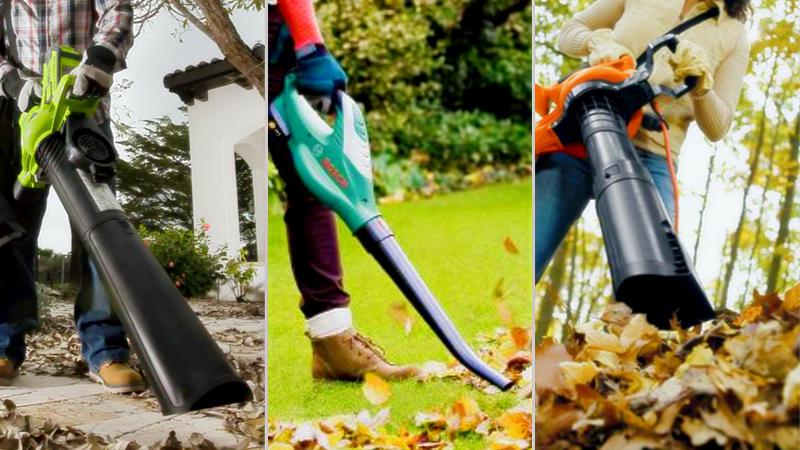
Clearing a lawn full of leaves is exhausting and time-intensive. That’s why leaf blowers are essential gardening tools. Whether it’s to rid your lawn of autumn leaves, clear walkways, or remove grass cuttings in the summer, leaf blowers are convenient all year round.
But with plenty of options and types available, deciding between petrol and battery-powered or large and small lawn use cases can also get overwhelming. So, we compiled the best among the lot, alongside other valuable tips, to help you choose a suitable model for your needs.
Our Top Picks
Suppose you're short on time and need to make a quick purchase. Here are our top three picks available in Australia:

Greenworks Cordless Leaf Blower
Best battery-powered leaf blower with a 297 km/h speed, 21 minutes operating time, and a brushless motor for power and durability.

STIHL Electrostart Petrol Blower
Best petrol leaf blower with a 2-stroke engine, 357 km/h speed, ErgoStart technology, and anti-vibration for commercial leaf-blowing tasks.

Bosch Leaf Blower & Vacuum
Best corded electric leaf blower, shredder, and garden vacuum with a 285 km/h blower speed and a 50 L collection bag.
Top 7 Leaf Blowers for Aussies
Our top nine picks for the best leaf blowers for Aussies are backed by in-depth reviews, countless hours of testing and researching, and insights gained from rigorous examination.
1. Greenworks 40V Leaf Blower
Best Battery-Powered Leaf Blower
Blower speed: 297 km/h
Operating time: 21 min
Warranty: 3 years
The Greenworks Cordless Leaf Blower offers good performance, durability, and convenience for medium to large yards with moderate to heavy leaf fall. The battery leaf blower has an airflow of up to 297 km/h, 21 minutes of battery runtime, and adjustable speed via its variable-speed dial.
It ships with a brushless motor designed to increase runtime, deliver more power, and reduce wear and tear. It also features a cushioned grip, which makes it comfortable to handle and operate. The 40V brushless leaf blower offers vacuuming and mulching capability with a 10:1 ratio. The blower and vacuum modes can be easily alternated.
GreenWorks’ leaf blower is attractively priced, but the total cost can increase once a battery and charger are added. Homeowners who already own compatible GreenWorks batteries can reduce expenses by purchasing the tool-only version. The blower uses GreenWorks G-MAX 40V 4Ah (146Wh) batteries, which are shared across a lineup of more than 60 tools.
Pros
- Long 21-minute operation
- Comfortable cushioned grip
- Vacuum and mulching capabilities
- 6-speed settings
Cons
- A bit noisy
- Additional cost for batteries and charger
2. Bosch UniversalLeafBlower
Best Value Battery-Powered Leaf Blower
Blower speed: 245 km/h
Operating time: 17 min
Warranty: 2 years
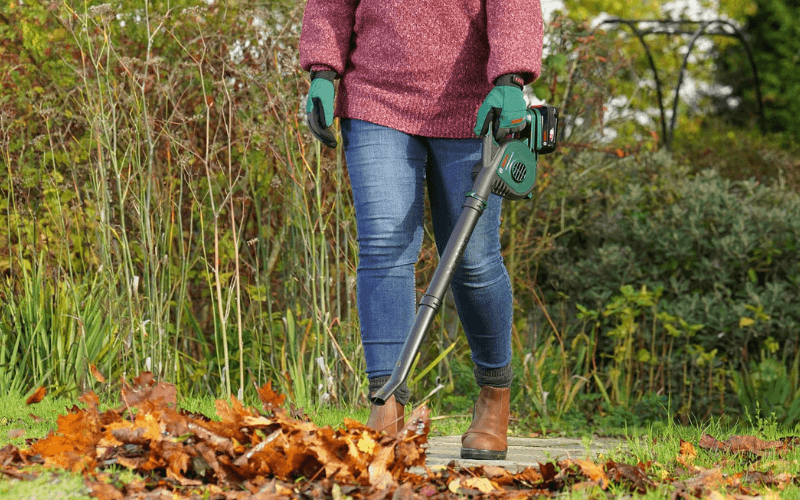
Bosch UniversalLeafBlower 18V-130 is a compact, battery-powered solution for fast and convenient outdoor clearing. It has a lightweight, handheld form factor, an ergonomic grip for easy manoeuvring, and a cordless design for unrestricted movement around patios and garden areas.
The blower has a 2-speed selection button for power, noise, and runtime balance, and an airflow speed from 185 to 245 km/h. The tool also has an inflator nozzle that expands its use cases; you can use it to inflate items such as air mattresses and paddling pools. And at just 1.6 kg, Bosch's blower is lightweight, comfortable to use, and easy to control.
Powered by an 18V lithium-ion battery, the blower offers up to 17 minutes of runtime with the supplied 2.5Ah battery. The battery, like Greenworks', is part of the Bosch POWER FOR ALL 18V system, ensuring compatibility with a wide range of Bosch Home & Garden tools.
Pros
- Comfortable ergonomic grip
- Lightweight and compact design
- Strong airflow performance
- Versatile inflator nozzle
- Battery compatibilty
Cons
- Runtime short for larger clearing tasks
- Air volume is lower than heavy-duty blowers
- Best suited for light debris
3. STIHL BR 450 Backpack Blower
Best Petrol-Powered Commercial Blower
Engine type: 2-stroke; 63.3 cc
Blower speed: 357 km/h
Warranty: 2 years
The STIHL BR 450 Petrol Backpack Blower is for extensive and commercial leaf-blowing tasks. It has a two-stroke engine with a dedicated 2-MIX technology that improves its performance and power efficiency. The leaf blower offers an air throughput or volume of 1.090 m³/h and a blowing speed of 357 km/h, the highest among the petrol leaf blowers on our list.
Despite its power, STIHL's leaf blower engine produces low emissions. It comes with the easy-to-start STIHL ErgoStart technology with a smooth, even pull. Even a gentle pull of the starter cord effortlessly starts up the engine. The blower also features an anti-vibration system that reduces vibrations in the handle, making your leaf-blowing experience pleasant. For convenience, the blower tube is fully adjustable to fit the user's height.
We recommend STIHL's leaf blower if you need a powerful tool for extensive and commercial leaf-blowing tasks. It weighs 11.5 kg, twice the weight of the Honda 4 Stroke Blower, has a power output of 2.9 kW, and has a 1.7 L fuel tank capacity. However, we do not advise it if you need a leaf blower for casual or small-scale tasks, as it might be too powerful.
Pros
- Easy engine start
- Low emissions despite its power
- Fully adjustable blower tub
- Excellent blow speed at 356 km/h
- Anti-vibration system
Cons
- Heavier at 11.5 kg
- Higher price point
4. Honda 25cc 4-Stroke Leaf Blower
Best Petrol Four-Stroke Engine Blower

Engine type: 4-Stroke; 25 cc
Blower speed: 252 km/h
Warranty: 4 years dom., 1-year com.
The Honda 25cc 4 Stroke Leaf Blower is a powerful and efficient model for large-scale and professional tasks. It's ideal for clearing plenty of cuttings, leaves, and debris, thanks to its four-stroke leaf blade and 25cc commercial engine for intense performance. Thus, we recommend it if you need to regularly clear a lot of leaves, debris, and cuttings from your property or work site.
Honda's petrol leaf blower is environmentally friendly and quiet during operation. It produces low emissions, and its fuel consumption is efficient. The leaf blower, with a 0.55 L fuel tank capacity, also requires no fuel mixing, unlike other petrol models available on the market. It has an anti-suction fan cover and a blower speed of up to 252 km/h.
As a bonus, the leaf blower is incredibly easy to start up. Professionals after a top-grade petrol leaf blower job or homeowners with plenty of leaves to shift would find the model incredibly helpful. It also comes with a four-year domestic and one-year commercial warranty. However, like the STIHL Electrostart, we do not recommend Honda's petrol blower for small-scale or residential leaf blowers, as it is more expensive, heavier, and less portable.
Pros
- Easy to start
- Powerful 25cc commercial engine
- Fuel-efficient and no fuel mixing required
- Anti-suction fan cover for added safety
- 1-year warranty
Cons
- Higher price point
- Not for small-scale or residential use
- Heavier and less portable
5. Victa Swift-Start Blower/Vac
Best Budget Petrol-Powered Blower

Engine type: 2-Stroke; 27.6 cc
Blower speed: 250 km/h
Warranty: 2 years
The Victa Swift-Start Blower is a reliable leaf blower with an easy pull start. Thanks to an isolated engine and a Walbro carburettor, it features an auto-choke and consistent performance with anti-vibration. Unlike the Honda model, Victa's leaf blower has a 27.6cc 2-stroke engine to blast debris away and a vacuum kit for gathering and shredding waste.
However, the Victa Swift-Start Blower is more expensive than most options. It's suitable for people who need a reliable yet economical tool to clear leaves and debris from large areas. It can vacuum leaves smaller than a 20-dollar note, but might struggle with larger or wetter leaves.
The petrol-powered blower, with a fuel tank capacity of 0.45 L, is also not very effective on grass or uneven surfaces, as it can miss or clog the suction tube. Thus, you can opt for the Honda 4-stroke blower for tougher jobs.
Pros
- Auto-choke feature
- Anti-vibration design
- 27.5cc 2-stroke engine
- Easy pull-start
Cons
- Relatively expensive
- Noisy during operation
6. Bosch 2300W Corded Electric Blower
Best Electric Leaf Blower
Blower speed: 285 km/h
Collection bag capacity: 50 L
Warranty: 1 year
The Bosch 2300W is a corded-electric leaf blower and garden vacuum for tidying your driveways, patios, lawns, and gardens. It offers good performance with a 2300w motor (up to 3,000W) that delivers an air volume flow rate of 160 l/s and variable speeds between 165 and 285 km/h.
The leafblower has three configuration modes. Along with shredding, you can use the tool to collect debris and leaves around patios and gardens. It can suck up waste in the garden using the vacuum mode, which has a capacity of 50 L. To switch from the leaf blower to the vacuum mode, replace the blower tube with the vacuum tube and the collection bag.
Bosch's electric leaf blower has a shredder function that condenses waste into materials you can quickly decompose in the garden. And while it may not be the lightest leaf blower, it is manageable at 3.4 kg. It goes up further to 4.7 kg when you include the vacuum mode.
Pros
- Variable speeds for versatile use
- Leaf blower, shredder, and garden vacuum
- Convenient for multiple outdoor cleaning tasks
- Easy switch between modes
Cons
- Requires an electrical outlet
- Less suitable for very large areas
- Limited range
7. WORX WG521 Leaf Blower
Best Lightweight Electric Blower
Blower speed: 217 km/h
Warranty: 3 years
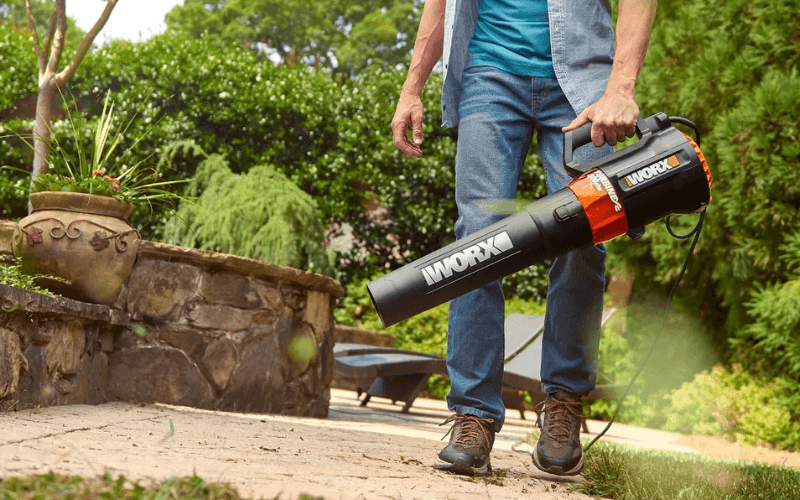
WORX WG521 Turbine Leaf Blower is for homeowners who want serious clearing power without moving to a gas machine. With up to 800 CFM and air speeds of 217 km/h, it has more than enough force to handle piles of dry leaves, pine needles, and even wet, stubborn debris.
In everyday use, the blower is strong and efficient, with a high-volume stream of air that moves debris quickly, reducing do-overs. Given its power, the 2-speed control is genuinely useful. Lower speeds help when working around doorways, corners, or delicate areas like mulch and gravel, while the high setting delivers a powerful blast for open spaces.
Despite WORX's performance, it remains manageable at about 3.0 kg. You'll find it comfortable for cleanup sessions, though the airflow force is noticeable at maximum speed. Noise levels are what you’d expect from a high-powered electric blower; not quiet, but reasonable given the output.
Pros
- Relatively lightweight
- Effective on both dry and wet leaves
- Tool-free and quick assembly
- Consistent performance
Cons
- Requires an extension cord
- Noise level typical of powerful electric blowers
- Not as convenient as cordless models
How to Use a Leaf Blower?
Leaf blowers are potent tools that require proper safety precautions to avoid injury from flying debris. To effectively use a leaf blower, here's a step-by-step guide to follow for efficiency and safety:
- Check the weather: Never blow wet or soaked leaves after rain or snowfall; this would be a much harder and counter-productive task.
- Wear safety gear: Always wear suitable protective gear. This includes eye protection, gardening gloves, face mask/covering, protective clothing/closed-toe shoes, and noise-cancelling ear muffs.
- Prepare your leaf blower: Ensure you fully charge the battery of your cordless leaf blower or have a spare battery ready.
- Adjust the airflow settings: Too much power and airflow will make a mess. Point the blower’s chute toward the ground directing the airflow under the leaves, not on top of the leaves.
- Move the blower chute from left to right: Create an arc-like motion as you walk and move the leaves into piles.
- Start with the nozzle close to the ground: Then raise it to a height where it does not generate dust.
Buying Guide: Choosing A Leaf Blower
You must always consider your needs when making a purchase. In your assessment of a suitable leaf blower, first, consider your lawn size. How much debris do you typically encounter per week? How many trees are on your lawn, and how big are they? Besides these, consider the following:
#1 - Fuel Type
A more powerful petrol option may be perfect for large estates with significant amounts of leaves and debris. But for most small homeowners doing the job themselves, the exhaust emissions, noise, fuel mixing, and maintenance required with petrol models can be annoying.
Homeowners with small to medium-sized lawns and patios should consider electric and battery-powered leaf blowers. Electric corded leaf blowers are limited in range but not in runtime. While multiple outdoor extension cords can extend the field, it's inconvenient. Battery leaf blowers can be as powerful as many petrol blowers, but the limitation is the need to recharge them.
#2 - Noise Level
It is important to consider noise levels when using leaf blowers. Consumer Reports recommends wearing hearing protection, goggles, and a dust mask for safety and health reasons.
#3 - Power
You need a powerful leaf blower if your trees shed many leaves throughout the year. Areas that don’t need much maintenance may be better suited to a cordless or electric model on a lower budget.
#4 - Airflow speed
The more airflow the leaf blower produces, the more effective it is at shifting heavier debris like wet leaves and grass. Manufacturers record this in kilometres per hour (km/h). When deciding, consider the work available to you and the airflow limits.
#5 - Accessories
Many leaf blowers allow leaf vacuuming and mulching, making collection and composting easy. However, some are easier than others to switch between vacuuming and blowing.
Some can be converted for other functions, saving the need to buy additional equipment. When purchasing battery-powered models, consider whether you have different tools that use the same brand of batteries.
Different Types of Leaf Blowers
There are several types of leaf blowers available on the market, each designed for specific tasks and preferences. Here are the primary types of leaf blowers:
#1 - Battery Leaf Blowers
Cordless leaf blowers are usually simple, easy to use, and inexpensive. They are convenient and get work done relatively quickly. When choosing a cordless leaf blower, look for the battery type, whether it comes with a charger, and whether it can supply sufficient power for your needs.
#2 - Petrol Leaf Blowers
Petrol leaf blowers, while powerful, are noisy and bad for the environment. However, they are also more challenging to maintain than the other modes available. Most professional lawn mowing or garden maintenance services do not carry petrol-driven leaf blowers. Homeowners should only consider petrol leaf blowers if they meet their required needs and leaf-blowing use cases.
#3 - Electric Leaf Blowers
While they cannot compete with the power of petrol leaf blowers or the manoeuvrability of cordless models, they offer some advantages. Notable among them are maintenance and price.
Electric leaf blowers are relatively inexpensive compared to other types of leaf blowers. They are also easier to maintain since they do not require any petrol mixing or battery change.
Frequently Asked Questions (FAQs)
Here are some frequently asked questions about leaf blowers in Australia.
How long can a leaf blower run?
The runtime of a leaf blower depends on the type and model of the leaf blower:
- Electric Leaf Blowers have a limited run time per battery charge. You can expect them to last 8 to 30 minutes on a single charge. The lifespan of an electric leaf blower is between 3 and 5 years with regular use.
- Gas Leaf Blowers can be taken far and wide for an indefinite time as long as you keep the tank full. A gas leaf blower should survive for more than ten years with careful maintenance and use.
Not that these vary based on the specific model and how well the leaf blower is maintained. We recommend referring to the manufacturer's instructions for specific information about your leaf blower.
What is considered a powerful leaf blower?
A powerful leaf blower is typically characterised by its air volume and speed, measured in litres per second (l/s) and kilometres per hour (km/h), respectively.
- High L/S: A higher l/s means the blower moves large volumes of air, and is effective for many leaves at once.
- High KM/H: A higher km/h means the air moves at a higher speed, and is useful for heavier debris and wet leaves.
The most powerful leaf blowers can reach up to 300 km/h and have at least 283 l/s.
Which is better, petrol or electric leaf blower?
Petrol leaf blowers are best suited for larger areas and demanding tasks, offering strong, continuous power and full mobility. However, they are noisier, produce fumes, require fuel, and involve more maintenance.
Electric leaf blowers are lighter, quieter, and easier to maintain, making them ideal for smaller yards. The trade-off is reduced power compared to petrol models.
Which is better 2 stroke or 4 stroke leaf blower?
For power and efficiency, a 2-stroke leaf blower is the better option. But if you prefer a quieter, more fuel-efficient option, a 4-stroke leaf blower could be more suitable.
2-Stroke Leaf Blowers are powerful, lightweight, and efficient. They require a mixture of oil and gas which goes directly into the fuel tank. These engines are less expensive to manufacture and simpler to use. However, they tend to be noisier and produce more air pollution.
Whereas 4-Stroke Leaf Blowers are generally quieter, more fuel-efficient, and have separate tanks for oil and gas. They are typically more suitable for those who prefer less noise and more fuel efficiency.
 Mark Thompson
Are Leaf Blowers Worth It?
Yes, leaf blowers are generally considered worth the investment for homeowners and commercial users. For homeowners and caretakers, they significantly reduce the time and effort required to clean up leaves and debris. They are also compact and easy to store.
For commercial users, leaf blowers are even more cost-effective than other options. They are essential tools for maintaining large properties and commercial spaces. However, consider their noise levels, environmental impact, maintenance requirements, and cost before deciding.









)

)