Did the lush green lawn of your new home impress you when you first moved in, only to become a source of stress when it’s time to mow? You’re not alone. Many Australians struggle to keep up with lawn maintenance due to busy lifestyles.
While some homeowners manage to find the time, certain mowing habits can actually harm the lawn rather than help it. A healthy lawn should be evenly green, free from weeds and pests, and without bare patches or ruts. Achieving this comes down to paying attention to small details.
Factors such as the type of mower you use, the grass variety in your lawn, and how quickly it grows throughout the seasons all affect the results. Although lawn mowing may seem daunting, the right approach and a few smart hacks can make it much easier and far more effective.
Know your grass
Mowing can be a much easier task for you if you know the ideal mowing height for the type of grass you have in your lawn. For example, if your lawn has the Sir Walter Buffalo Grass or the Eureka Kikuyu Grass, you should keep the mowing height at around 40 mm.
On the contrary, lawns with couch grass varieties like the Nullarbor Couch can safely be mowed at 15 mm without any damage to the grass. As a rough guide, never mow down more than two-thirds of its original height. This rule is popularly known as the rule on one-third and emphasises the importance of always leaving the grass at one-third of its original height.
Fix a regular schedule for mowing
While this hack will not be easy to manage because most of us have a shortage of time, you must mow your lawn at regular, fixed intervals to keep the grass happy and to avoid overgrowth. It is to be noted that grass will grow differently in different seasons, and you might have to be more frequent at some times of the year.
Failure to do so will lead to an overgrown lawn and the likelihood of damaging the grass while mowing it. If you think you won’t be able to mow your lawn at set intervals, it is better to hire a professional to do it. This arrangement will turn out to be better than mowing overgrown lawns.
Don’t mow too short
The growth of grass in our lawns seems to be directly related to our busy lives. The busier we are, the faster our lawn-grass grows. The end result is that we have to mow our overgrown lawns.
While it may seem to be a great idea to trim them down to a really short height, doing this would most likely kill the grass or scalp the lawn. This practice will also increase the likelihood of weed growth in your lawn. It is advisable to mow the lawn in stages, with the first cut being very high.
Gradually, the mowing height should be decreased so that the crowns of the lawn begin to grow further down inside the thatch layer. An exception to this is the Couch grass variety, which is an Australian favourite. This grass can usually withstand a low mowing height because it has runners underground, which help it to regenerate fast.
Mow at the right time
While getting an early start to your day might make you feel productive, mowing your grass too early is not. When the grass is still covered in dew, it is more likely to be damaged and pulled from its roots.
If you think midday is a good idea, think again. During midday, when the sun has reached its peak in the sky, your grass is hard at work holding on to every last drop of water for survival. At this point, your grass is also working on photosynthesis.
Mowing in the peak heat of the day is as disturbing to the grass as it is to you. The grass being mowed down experiences a lot of stress in the process. The grass will lose much more moisture, and its recovery will be much slower if it is mowed in high heat. Choose the time of the day when the sun is not directly overhead, or the lawn is shaded.
If you’re someone who likes to sleep in on the weekends, then you’re in for a treat, as mowing the lawn in the early evening is ideal.
Grass-cycling
With a simple modification of your good old mower, you will be able to save a lot of time, money, and energy. You only have to replace your mower blade with a mulching blade. This simple hack will result in the generation of much smaller pieces of cut grass, which can be left on the lawn to decompose.
Because they decompose pretty quickly, they will not look conspicuous, and at the same time, your lawn will get some goodies in the form of natural fertiliser. There is just one thing to keep in mind- you might have to attach an adaptor at the end of your mower when you use a mulching blade to make sure that the mower does not shower the cut grass on you as you mow.
A word of caution: this hack will only work for lawns that are regularly mowed. Overgrown lawns will have to be gradually brought down to their ideal mowing height before starting grasscycling.
Get creative when mowing
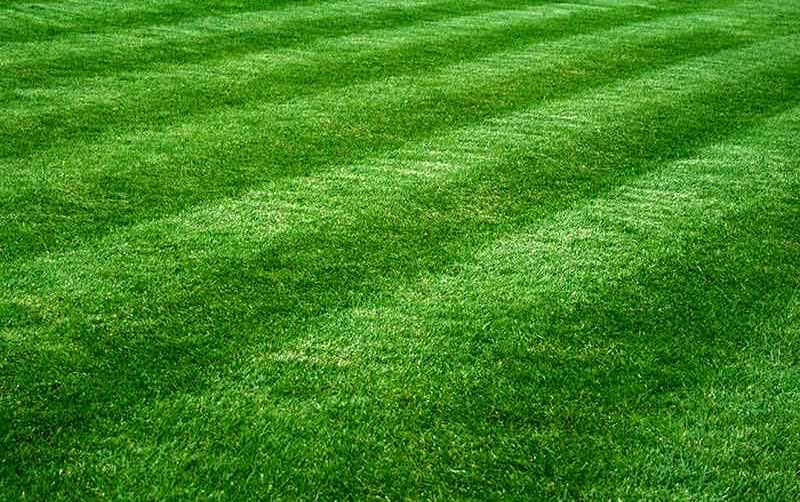
Contrary to popular practice, mowing in a single direction is not recommended. Repetitive mowing in the same direction will create ruts, and the soil will get compacted in that direction, thereby hampering the growth of grass and allowing weeds to grow.
Also, mowing in the same direction every time will create a grain on the cut blade of grass, and eventually, the grass tends to lean in the direction of mowing. This will result in the grass not being upright and mowing not being efficient.
So, the next time you mow your lawn, think of different patterns you can make with the mower. Alternatively, you may think of lawn mowing as a form of exercise and try to make the patterns more interesting every time.
Steer clear from slopes
However tempting the lawn on a slope is, never mow it in the vertical direction. Instead, gently make horizontal movements on slopes. Depending on the slope inclination, it might even be better to use a string trimmer or opt for ground cover. In case of any doubt, please check with the manufacturer of your lawnmower for information regarding its usage on slopes.
Check the mower
Perhaps one of the most important factors for hassle-free lawn mowing is the condition of the mower and its blade. Maintain your lawnmower well and check the blade for sharpness. Blunt blades are not capable of creating sharp cuts on the grass blades and cause damage to the structure of the grass.
Also, these blades are not able to cut a uniform height of the lawn. Getting the blade sharpened periodically increases the efficiency of the mower and saves a lot of time and effort. Sharpening of mower blades can be easily done at home or by hiring a professional, but this step must not be overlooked.
Switch up your Mowing Routine
The grass will grow based on the direction you cut it in. It will lean with the grain that you choose. To combat this, use different routes. This will promote the upward growth of the grass. While you should switch up the pattern you mow, always push the mower forward. This will help the grass that becomes coarse and help prevent it from sprouting unevenly as well.
Nourish the lawn
Adding fertiliser to the lawn should not be neglected because it makes the grass grow faster and necessitates more frequent mowing. Fertilisers provide a lot of critical nutrients to the grass, which helps it to withstand mowing, gives it an edge over opportunistic weeds, and results in faster repair of the grass. You must schedule fertiliser addition to your lawn as you would schedule their mowing.
Mow only dry grass
It is advisable only to mow grass that is completely dry. The grass stays upright when it is dry and tends to stick to each other or lean in a particular direction when it is wet. In addition, mowing wet grass lawns may require a lot more time and effort and, at the same time, leave the mowed lawn more susceptible to microbial infections and infestations.
Make edgings where required
This simple hack will save a lot of your time and effort while mowing. Creating a flat surface (also known as mower strips) on the edges of your lawn, such as long walking paths, planters, and driveways, will make it possible for you to move the mower on these flat surfaces.
This would make the string trimming dispensable and provide a neat and finished look to the edges of your lawn. You can get really innovative with the type of material you want to use for creating these flat edgings. Crushed limestone, bricks, gravel, or concrete can be used for this purpose.
These simple steps will not only reduce your effort while mowing your lawn, but they will also result in healthier, lush green lawns that will be a sight for sore eyes. So, follow these tips and tricks to become the neighbour whose grass is always greener.