Bare patches and thinning grass are often signs of underlying soil problems, with compaction being one of the most common causes. When soil is compacted, air, water, and nutrients struggle to reach the root zone, while trapped carbon dioxide and reduced oxygen levels weaken healthy growth.
Over time, this stress leaves lawns vulnerable to disease, drought, and pest damage. Lawn aeration addresses these issues by loosening the soil, improving circulation, and restoring conditions.
- If your looking for a great guide to lawn aeration read on.
- If you already know you want a lawn aerator then read our guide to the best lawn aerators on the market.
- If you need to aerate your lawn, but don't have the skills, desire, tools or time, consider hiring a professional lawn care service.
Benefits of lawn aeration

You aerate your lawn to eliminate the soil compaction that is preventing the circulation of nutrients and water.
Aeration means perforating the soil with small holes to permit air, water, and other nutrients to penetrate to the deep roots of grass. Once the roots are strengthened, you will see a healthier lawn.
The benefits of Aeration include:
- Relieves surface compaction and encourages the growth of new roots
- Increases the depth of roots
- Improves uptake of nutrients
- Reduces the buildup of thatch below the surface
- Stimulates the soil-borne microbes, which are important in maintaining healthy soil
- Improves the permeability of the soil
- Improves drainage, reducing the risk of fungal diseases like red thread
- Improves the exchange of air between the soil and the atmosphere
Aerating the lawn is actually also an eco-friendly practice, as a healthy lawn increases the oxygen in the atmosphere. A clean and grassy lawn is helpful for your children and pets to live and breathe in a fresh atmosphere.
Should you carry out lawn aeration?
If your lawn gets very active use, like the regular running around of many children or other heavy usage such as from tradesmen doing renovations, then you may notice your lawn has started to feel spongy, or that the soil is drying out quickly.
You may also notice excessive thatching. Drainage problems are also indicative of a need for aeration; if puddles of water remain all over the lawn after rain, that is a solid indicator of a compacted lawn.
Even without any of the symptoms above, aerating once a year is advisable for the health of your lawn, and you will get back by not needing to dig up and reseed your bare patches so often. Of course, you should consider getting a lawn care professional to carry out lawn aeration for you.
Spike vs Plug Aeration
Aerating mechanisms fall broadly into two categories: spike/slit aerators and core/plug aerators. With a spike aerator, you are using the tool to poke holes into the ground, much like with the garden fork.
Plug aerators remove a core or plug of soil (and grass) from the lawn. For the best results, you would use a plug aerator, as a spike aerator makes a much smaller, shorter-lived perforation in the soil and can actually cause additional compaction in the areas around the holes. You will end up needing to aerate more often if you use a spike aerator than if you use a core aerator.
The bigger holes made by a core aerator will fill with water during heavy rain; this means your soil has a better chance of absorbing the extra water that might run off if the soil is not aerated at all.
These larger holes also permit grass seed (if you are over-seeding after aeration), top dressings, fertiliser and grass clippings to reach deeper into the soil and remain in the soil more effectively than spike/slit aerators. Many lawn care professionals like TruGreen suggest a combination of methods may be best, alternating spike aeration between each plug aerating.
There are also ‘liquid aerator’ or ‘ionising soil conditioner’ products on the market, which are claimed to work on a microscopic level by using opposing charges to push soil colloids apart. The consensus in the industry seems to be that there is no evidence that these are worthwhile or not.
Manual Lawn Aeration Tools
Aeration can be carried out on very small areas just using a garden fork. However, once it became clear that lawns benefited from aeration, special tools were invented, and now there are several types available. Below are a couple of different kinds of manual lawn aerators that you may choose for occasional use or small lawns. We will describe motorised models later.
Aerator Shoes or Sandals

These allow you to walk around your garden, making little holes with the spikes; you wear them over your normal shoes. Of course, you won’t get very deep into the ground with these, and of course, they do not pull out plugs of soil, but you can pick up a pair for just $15 from Bunnings or eBay.
You would need to use them quite often to do very much at all. You can always wear them at the same time as mowing the lawn to do two jobs at once. Best used in conjunction with a plug-removing aerator.
Long-handled fork-like Aerators

These aerators are easy to use for the able-bodied, and they do not need a large storage space.
- Spike: Manual spike aerators possess long spikes which are pushed and inserted into the soil. You use them like a fork; of course, they have a lot more spikes than a fork.
- Plug removal: Again, you use these like a fork and push down on them. Rather than spiking lots of little holes, they have fewer prongs that remove plugs of soil.
It is a practical option for those who find fork-style tools difficult to use and for smaller gardens, offering a cost-effective alternative to hiring a mechanical aerator.
While it remains slower than a motorised aerator, it provides greater ease of use and control. The above aerators can all be used near obstacles, so even for larger areas, they can be used as a complement to a motorised aerator.
Motorised Mechanical Aerators
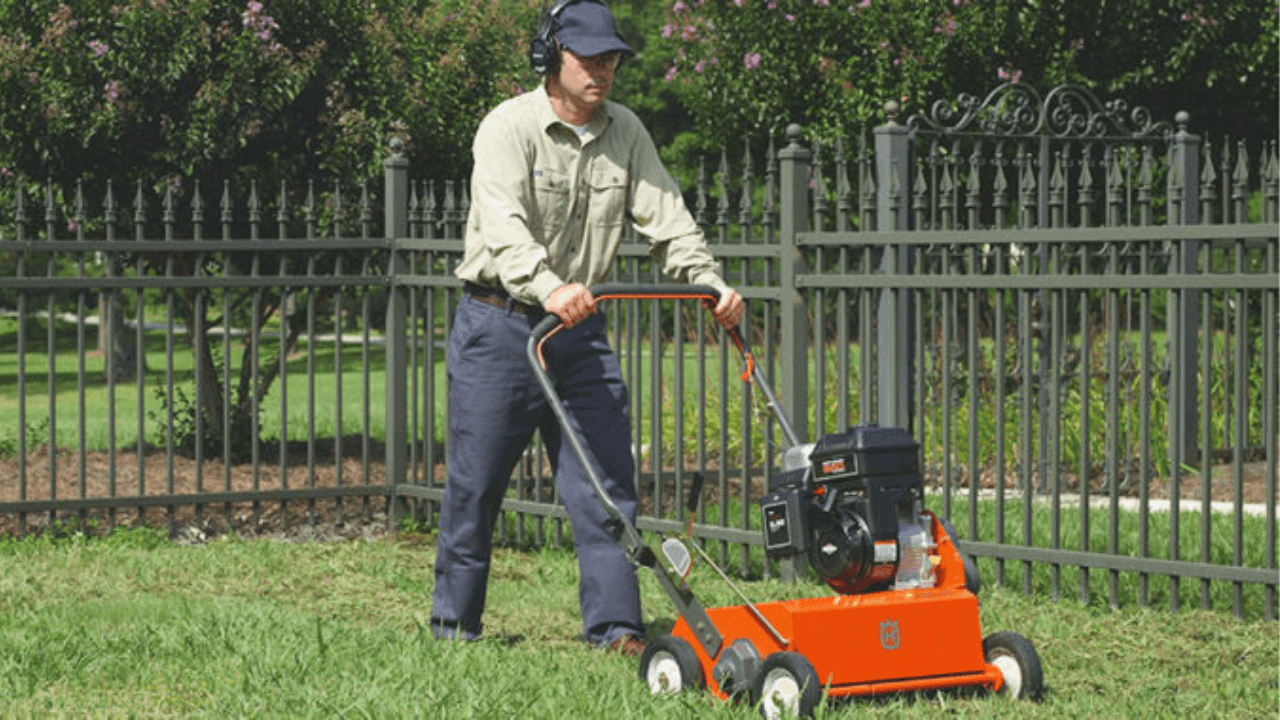
Motorised mechanical aerators can be self-powered, and you walk behind them like a home lawn mower.
Much less exhausting than fork-type aeration tools, they produce holes rapidly and efficiently. The deeper holes enhance the transfer of water, air and nutrients to the deep roots.
There are two variations in the mechanism used for mechanical aerators: drum and cam, or piston, units. The main difference is how their tines are driven, as well as the hole spacing.
- Drum-type aerators have a tine wheel (a cylinder containing spikes that you roll over the surface of the lawn), which rotates and relies on weight for tine penetration and offers a fixed hole pattern.
- Cam units are driven by a camshaft that reciprocates and drives the tines up and down into the soil. Cam designs can produce denser hole patterns if the speed slows. And cam designs have fewer tines than drums. The machines of the cam style achieve a greater depth of soil penetration. These cam units are normally plug-removing aerators.
For another example of a good push cam unit, take a look at this video from Home Depot featuring a Classen Aerator.
Tow behind Aerators for large areas
While you can get aerators that you walk behind, you can also purchase large tow-behind aerators that are designed to be pulled by ride-on mowers or lawn tractors. These also come in spike/slit vs core/plug varieties.
You should be able to tow a spike/slit aerator using a standard ride-on mower to make an efficient combo operation. Plug-removing lawn aerators require a more substantial tractor to pull, because of the resistance caused by the weight required to penetrate the soil. Most tractors have enough horsepower, but the light-duty lawn tractor transmissions may be insufficient.
The main downside of a core aerator is that they are significantly more expensive, and you will have to decide if you want to buy and maintain it, or rent one for a day's use. A slit or spike aerator is cheap enough that you can buy one and aerate whenever you want. Some models allow you to aerate while also spreading seed or fertiliser during the aerating process.
Dethatching vs. Aerating
Thatch is all the dead grass tissues present in the layer of grass; no matter what variety the grass is, it can develop excessive thatch, which causes a reduction in the nutrients and air.
To remove thatch, you can rake the lawn with a thatching rake or use mechanical tools. These tools loosen up the surface layer of soil. For more information, follow our guide on how to dethatch a lawn.
How to aerate your lawn
We asked some of our specialists, and they came up with the following advice: follow their advice (or hire them via expertEasy) to get the best results.
When to carry out lawn Aeration
It is ideal to aerate the lawn once or twice a year. You can do it nearly all year round except when very dry weather is expected, or the ground is frozen, early in autumn, spring or late in summer are all good times.
The earth should not be waterlogged, the turf would have had a good watering and be slightly soft but still firm, this especially applies if you are doing core aerating. Do not aerate during a drought, as then the holes can crack open. If the ground is frosty, wait until later in the morning when the frost has gone before you start aerating.
What to do before aerating
- Mow your lawn very short, ideally the day before, and optionally perform light dethatching/scarification, but not heavy scarification, as the combination would overstress the lawn.
- Mow your lawn again and collect your grass clippings to ensure the surface is free of debris.
- If the ground is too hard, you will need to water it for around an hour first.
- If you have pop-up sprinklers, use some kind of markers to identify where they are situated so that you do not damage the sprinkler heads.
 Mark Thompson
Aeration using a garden fork or aerator fork
Dig the fork into the soil at least 10cm, now move the fork back and forth to create some nice, large holes, really disturbing the soil beneath the lawn. Breaking up the soil thoroughly to remove the effects of compaction. Repeat the process in rows at 10 cm or less apart.
Aeration using a mechanical aerator
- Watch out for obstructions like rocks, tree roots and old paths.
- Occasionally, look behind the machine to make sure it is not lifting the turf as you go along.
- You should use the aerator in a couple of different directions
- Be careful not to turn the machine with the aerator spikes in the soil, otherwise it will rip up the surface of the lawn.
After Aerating
- Leave the cores on the grass.
- To keep the need for aeration to a minimum in the future, add plenty of worms to the lawn.
- Allow the lawn to dry out, and don't water again until the earth is dusty and you can leave footprints on it. Only when you are able to see your footprints left on your lawn should you then water deeply. You want the roots to search for the water underground.
- When it is time to water, you can fertilise and overseed with new grass seed. Then return to normal fertilising - with a slow-release organic fertiliser at least twice a year.
A common mistake is to cut your lawn too short; mow regularly at a higher mowing height. Your lawn should now be in amazing shape.
Mark Thompson
Final Thoughts
Lawn aeration is one of the most effective ways to restore soil health and encourage stronger, more resilient grass.
It relieves compaction and improves the movement of air, water, and nutrients. Aeration also helps prevent bare patches, enhances root development, and reduces vulnerability to drought, pests, and disease.
Consistent aeration, ideally once or twice a year, delivers long-term improvements in turf quality. This schedule, combined with proper watering, mowing, and occasional overseeding, helps maintain a dense, healthy, and visually appealing lawn.