
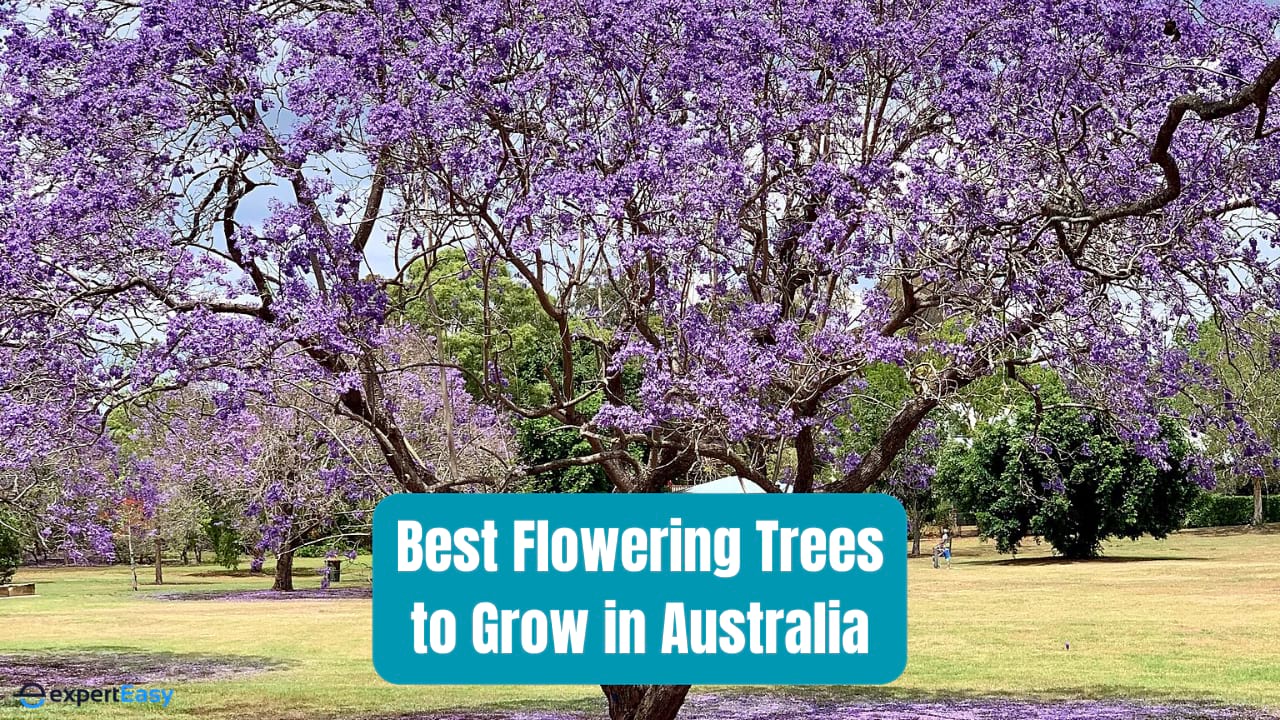
Australia is home to some of the most diverse natural landscapes in the world, from long coastlines to mountain ranges and sandplains. It also ranks third globally for endemic flowering species.
If you want to add a flowering tree to your garden, there are plenty of great options for different garden types and growing seasons. We highlight some of the best choices based on when they thrive.
1. Golden Chain Trees

Golden Chain tree, or Golden Laburnum (Laburnum anagyroides), is a deciduous ornamental tree known for its long clusters of bright yellow flowers that bloom in spring.
It has green trifoliate leaves and is widely grown for its striking seasonal display. It grows best in well-drained soil and full sun. Regular pruning helps maintain its shape and supports healthy growth.
2. Crabapple Trees

Crabapple trees (Malus spp.) are valued for their spring blossoms, ornamental fruit, and strong garden appeal. Their flowers bloom in shades of white, pink, and deep red, attracting pollinators such as bees and butterflies.
The fruits look like small apples and range from sweet to tart. They can be used in preserves, jellies, and other recipes. If you want to grow crabapple trees, choose a variety suited to your climate and soil. They are often started in pots and transplanted as they mature.
3. Jacaranda Trees

The Jacaranda tree (Jacaranda mimosifolia) has vivid purple-blue flowers and fine, fern-like leaves.
It is a popular ornamental tree in warm and subtropical parts of Australia, including Sydney, Brisbane, Adelaide, Perth, and Northern New South Wales. In spring to early summer, it produces a dense canopy of colour that makes it a standout in streets, parks, and gardens.
Jacarandas also grow quickly and provide broad shade once mature. They can grow about 10 feet per year and usually reach 25 to 40 feet tall. Flowering time varies slightly depending on local weather and climate.
4. Cherry Blossom Trees

Japanese Cherry Blossom (Prunus serrulata) has soft pink or white spring flowers. In Australia, it is best suited to temperate areas and is valued for both its beauty and seasonal impact.
It grows best in well-drained soil and full sun. With the right care, it produces strong spring flowering, though the blossoms usually last only one to two weeks. That short bloom period is part of what makes the tree so special.
5. Crepe Myrtle Trees

Crepe Myrtle (Lagerstroemia indica) is a popular flowering tree with a long blooming season, a strong colour range, and the ability to handle warm conditions. From late spring through summer, it produces large clusters of flowers in pink, lavender, purple, white, and red.
It grows well in many parts of Australia, especially in warm, sunny regions such as Queensland, New South Wales, Victoria, South Australia, Western Australia, and the Northern Territory.
It also performs well in hot, humid conditions. As it matures, the bark peels back to reveal smooth patches underneath, adding extra visual interest.
6. Ivory Curl Trees

The Ivory Curl Tree (Buckinghamia celsissima) is a standout native Australian tree with hanging clusters of creamy, bell-shaped flowers. Native to the rainforests of Queensland and New South Wales, it flowers in spring and summer and adds a light fragrance to the garden.
It also supports local wildlife by providing nectar and habitat for birds and insects. It grows best in well-drained soil with partial to full sun, needs regular watering while establishing, and becomes more drought-tolerant as it matures. Pruning can help maintain shape and healthy growth.
Its moderate growth makes it suitable for both small and large gardens. In the wild, it can reach up to 30 metres, but cultivated trees usually stay much smaller.
7. Cape Chestnut Trees

Cape Chestnut (Calodendrum capense) is valued for its large clusters of bell-shaped flowers that bloom in spring and summer. The flowers range from pink and mauve to white, set against glossy dark green leaves. After flowering, the tree produces large woody seed capsules.
It grows best in well-drained soil and needs regular watering while establishing. With a moderate growth rate, it can reach up to 20 metres and forms a rounded canopy, making it well-suited to larger gardens and parks.
Once established, it becomes more drought-tolerant and mainly needs pruning to maintain shape and healthy growth.
8. Evergreen Magnolia Trees

Evergreen Magnolia (Magnolia grandiflora) has large, creamy white flowers, which grow up to 30 cm across and have a strong, sweet fragrance. It also has glossy, leathery dark green leaves that stay on the tree year-round.
It grows best in well-drained soil and full sun, but it can adapt to different soil types. With its naturally pyramidal shape, it can grow into a large tree, reaching up to 27.5 metres tall.
9. Forsythia Trees

Forsythia is a deciduous shrub with bright yellow flowers that appear in early spring before the leaves emerge. Its arching branches give it a soft, cascading shape, while the simple green leaves provide a clean backdrop once flowering ends.
It is easy to grow, does well in well-drained soil and full sun, and can handle a range of soil conditions. Pruning after flowering helps maintain its shape and supports healthy growth.
Forsythia is often used for hedging, borders, and garden edges, where it adds strong early-season colour as winter gives way to spring.
10. Golden Wattle Trees

Golden Wattle (Acacia pycnantha) is Australia’s national floral emblem and one of its most recognisable native trees. It is a small to medium evergreen tree, growing up to 8 metres. It has bright yellow, ball-shaped flowers that appear in spring, and a dark green foliage and textured bark add to its appeal.
Golden Wattle is tough, adaptable, and grows well across many Australian environments, from coastal to inland areas. It is used in revegetation because it supports wildlife and helps restore landscapes.
The tree has strong cultural and ecological importance. Indigenous Australians have used it for food and tools, while its nectar-rich flowers attract bees and other pollinators, supporting local biodiversity.
Growing Flowering Trees in Your Australian Garden
Each tree species has specific care requirements, so it's essential to research and understand the needs of the particular flowering tree you're growing. But that aside, keep the following best practices in mind:
#1. Choose a Suitable Location
Pick a planting spot that suits the tree’s mature size and light needs. Make sure it will not crowd buildings, power lines, or nearby plants as it grows.
Then prepare the soil properly. Improve drainage and structure, check pH and nutrient levels, and mix in organic matter such as compost or well-rotted manure to support strong root growth.
#2. Planting Your Tree
Plant the tree in autumn or early spring so it has time to establish before extreme weather. Always follow any species-specific planting advice first.
If there are no special instructions, dig a hole wider and slightly shallower than the root ball. Remove the tree from its container carefully, place it in the hole, backfill with soil, and keep it at the same depth it was growing before. Water it well after planting to help settle the soil around the roots.
#3. Caring for Your Tree
To take proper care of your tree after growth, keep the following in mind regarding watering, mulching, pruning, and fertilisation.
Water the tree regularly while it is establishing, then reduce watering as it matures. Add mulch around the base to hold moisture, control weeds, and keep soil temperature stable.
Prune properly to shape the tree, remove dead or diseased growth, and support healthy development. Apply a balanced slow-release fertiliser during the growing season to supply essential nutrients.
#4. Pest and Disease Management
Regularly inspect the tree for signs of pests and diseases. Identify and address any issues promptly using pest techniques like natural predators, organic sprays, or other environmentally friendly solutions.
#5. Patience and Care
Depending on the tree's growth habit, consider installing support structures like stakes or ties to help the tree grow upright and stable, especially during its early years. Growing a flowering tree is a long-term commitment.
Frequently Asked Questions (FAQs)
Here are some frequently asked questions on growing flowering trees in Australia.
What flowering trees are easiest to grow?
The easiest flowering trees to grow are usually the ones that handle local conditions well and need minimal maintenance. Good options include crepe myrtle, golden wattle, jacaranda, and magnolia. These trees are generally hardy, adapt well to different soils, and produce strong seasonal blooms with basic care.
What tree stays in bloom the longest?
Crepe myrtle is one of the flowering trees that stays in bloom the longest. It can flower from late spring through summer, giving it a much longer display than many trees that only bloom for a week or two.
What is Australia's favourite tree?
Australians chose the River Red Gum (Eucalyptus camaldulensis) as their favourite native tree in a national poll conducted by ABC. The iconic tree, with its distinctive appearance, sturdy presence, and cultural importance, holds special significance due to its prevalence in the Australian landscape and its vital role in supporting various ecosystems.
 Mark
Mark
Crafting Your Garden
Australia’s flowering trees reflect the richness of the country’s landscapes and ecosystems. Their colour, form, and seasonal impact are a clear expression of Australia’s natural character.
Adding these trees to a garden or workspace improves appearance, brings in shade, colour, life, and a stronger connection to the natural environment. Each one has the power to transform a space.











.jpg)


_-_Steiglitz,_Victoria_Australia_(4804368492).jpg)


